
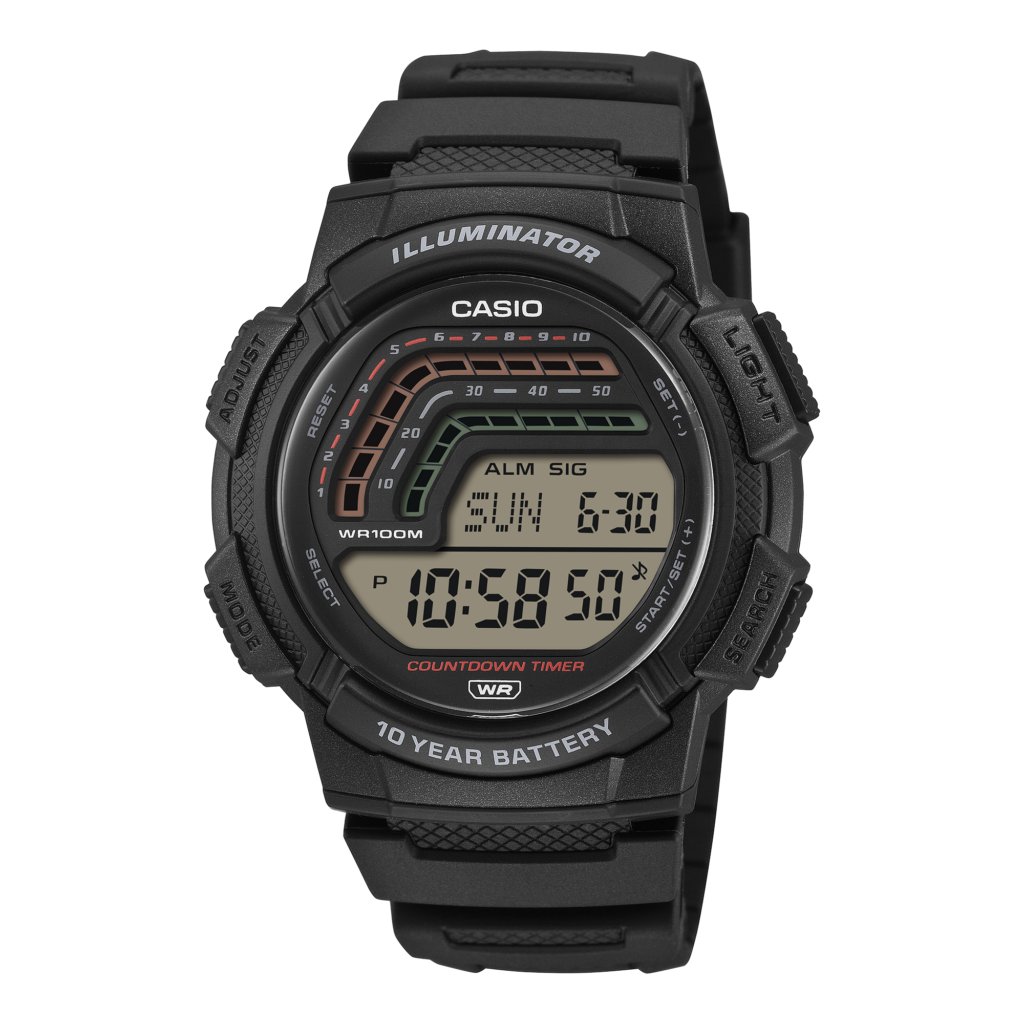
Quick answer: Choose an analog watch if you want a classic look for work and occasions, and a digital watch if you want exact time, a backlight, alarms, a stopwatch and longer battery life (often 7–10 years on Casio digitals). An analog-digital watch gives you both.
Digital vs analog watches: choosing between them is really a choice about how you spend your day. Here is a side-by-side look to help you decide — with Casio examples you can try on at our Dubai store.
Digital vs analog watches at a glance
| Analog | Digital | |
|---|---|---|
| Look | Classic, smart, timeless | Sporty, retro or technical |
| Reading the time | At a glance from the hands | Exact numbers, easy in low light with a backlight |
| Extra functions | Date, day, moon phase on some models | Stopwatch, alarms, timers, world time, light |
| Typical battery life | About 3 years (e.g. MQ-24, MTP-V005D) | 7–10 years (e.g. W-218H, W-800H, WS-1800) |
| Best for | Work, occasions, gifts | Sport, school, travel, outdoors |
Choose analog if…
- You want a watch that works with office clothes and evening wear.
- You prefer a clean, simple dial over buttons and modes.
- You like details such as a date window or moon-phase dial.
Good picks: MQ-24 (light and minimal), MTP-V005D (steel and smart), MTP-1374L (multi-dial executive look).
Choose digital if…
- You train, run or swim and want a stopwatch, timer and 100 m water resistance.
- You need alarms, world time or a backlight for early mornings and night shifts.
- You love the retro 80s look.
Good picks: W-218H (retro square), W-800H (tough everyday), WS-1800 (interval timers for training), WS-1700H (tide and moon data).
What is the difference between a digital and an analog watch?
An analog watch shows the time with hour and minute hands moving around a dial. A digital watch shows the time as numbers on an LCD screen. Most modern analog and digital watches both use quartz movements powered by a battery, so both keep accurate time. The real differences are in looks, functions and how easy they are to read in different situations.
Which is easier to read?
An analog dial lets you see the time at a glance and judge how long is left before a meeting. A digital display gives the exact time to the second and, with a backlight, is easier to read at night. Many people find analog quicker for everyday use and digital better for timing workouts or cooking.
The best of both: analog-digital watches
Can’t decide? An analog-digital (ana-digi) watch has hands and a small digital screen. You get a classic look plus alarms, a stopwatch and world time. Good examples are the Casio AMW-880D on a steel bracelet (AED 285) and the square AQ-240E (AED 195).
Why not both?
Many people keep one of each: an analog for work and a digital for the gym and weekends. With Casio prices starting from AED 47, that is easier than you might think.
Curious about the world’s best-selling digital watch? Read our Casio F-91W guide.
Frequently asked questions
Are digital watches more accurate than analog watches?
Not really. Most digital and analog watches today use quartz movements, which are very accurate. Only mechanical (automatic) analog watches are noticeably less accurate. Learn more in our guide to automatic watches for men.
Are analog watches more formal?
Yes. An analog watch with a steel, gold or leather strap is the usual choice for the office, weddings and formal events. See the best Casio watches for men for smart analog picks.
Which is better for kids and students?
Digital watches are easier for young children to read, and models with a stopwatch and alarm are handy for school and sport. Older students often like retro digitals; see our Casio vintage watch guide.
Which lasts longer on one battery?
Many basic digitals run for 7–10 years on one battery, while most simple analog watches need a new battery after about 3 years.